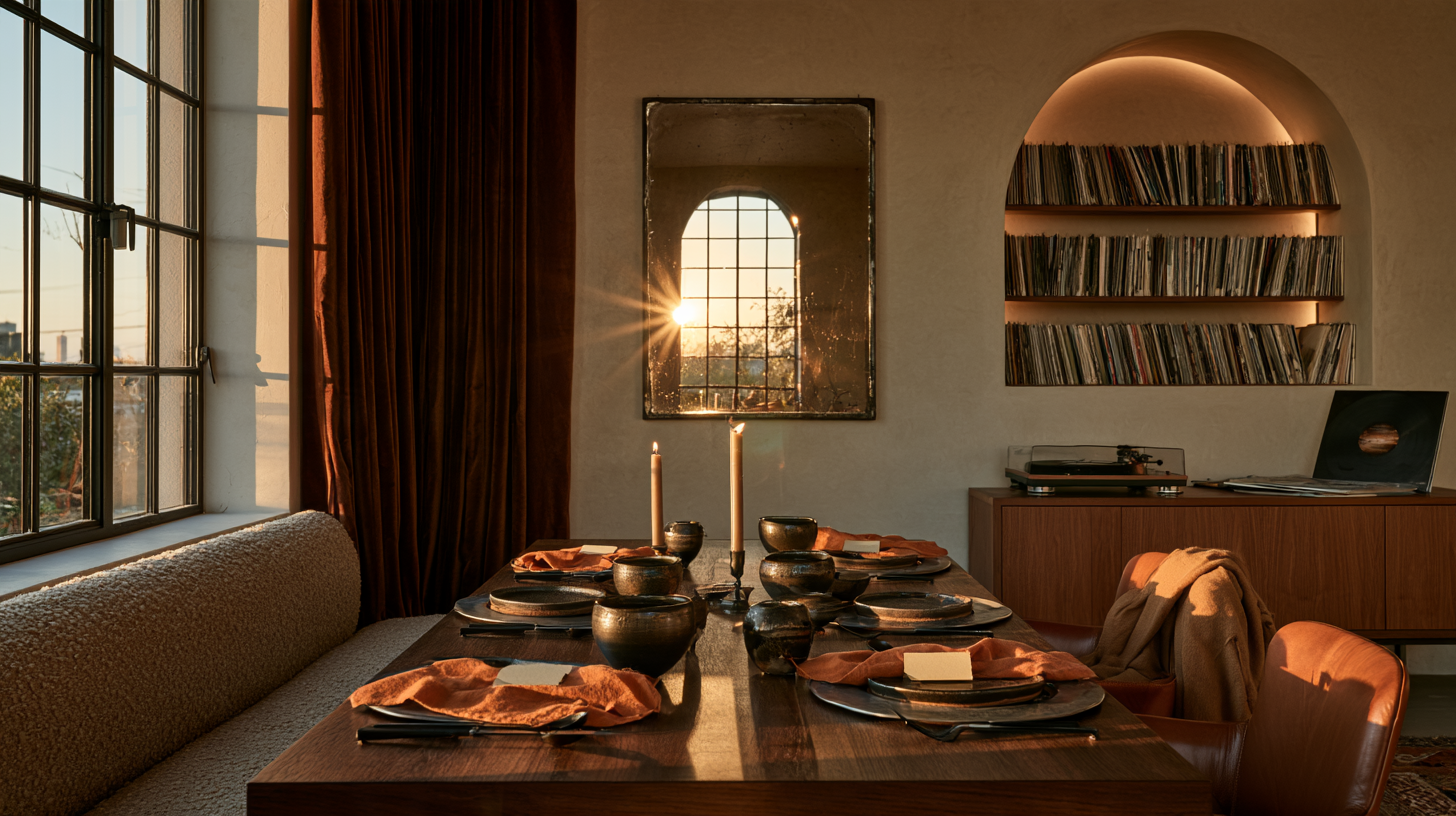
October is the first cozy month of hosting, and the first one that lets you lean into the deeper part of the year. Meals get heavier, desserts get richer, the wine turns red and the music turns soulful. It's a month that can hold some of the most beautiful gatherings of the year, if you're willing to host the season at its darkest.
Because the thing that changes most in October isn't the menu. It's the light. By the second week of the month the sun is down before most dinners start, and you are no longer hosting a lit room that happens to have candles in it. You are hosting in the dark, whether you planned to or not. This post is about planning for that on purpose.
New to hosting? You're in the right place. Everything here is broken into small steps, and you can borrow as much or as little as you like.
The quick version
Pick three colors: smoked fig, clove brown and tangerine peel.
Light the room low and warm, with lamps and candles. Turn off any cool white lights.
Set one place well, then repeat it for every guest.
Cook dishes that can sit and wait, so you can stay at the table.
Keep everything below eye level so people can see each other.
Send the invitation two weeks ahead and say the time plainly.
I. Be Bold, Choose Depth
The option you'll see most this time of year is the autumn harvest table: warm oranges, reds and yellows, browns and beiges. It's lovely, and it can be done beautifully, but it isn't a bold choice, and it leaves very little room for personality.
The bold choice is the evening table: smoked fig, bright persimmon and low light. Red wine, a hearty supper, a rich dessert. It asks a little more of you, because there's nothing pale to hide behind, and it gives a lot back. Everything on it is deep and lived-in: dark glaze, heavy linen, a glass of red catching the flame. Dinner runs longer than planned, and the conversation slows down with it. A table like this feels like an occasion before anyone has sat down.
It's also the oldest idea in hosting. For most of human history, every dinner after dark was eaten by firelight or candlelight. Low light isn't a trend you're adopting. It's simply how dinner has always looked when people wanted to stay at the table. The dark isn't an absence of design. It's the material you're designing with.
II. Start With Three Colors
You only need three colors for the whole table. Each one has a job, and they don't have to match.
Smoked fig is the main color. It's a deep purple-brown. It isn't plum or black cherry, and that matters: in candlelight, true plums and black cherries tend to turn flat black. Fig has enough brown in it to keep its color, so it reads as glaze, fabric or wine, something with depth, instead of a hole in the table.
Clove brown is the background. It's the warm dark that everything else sits on: the wood of the table, the walls at the edge of the candlelight, the shadows between the plates. Dark surfaces soak up light instead of bouncing it back, which is what makes the lit things glow.
Tangerine peel is the one bright note. Use it once, in one place per seat: the napkin. An orange that leans yellow keeps its glow in low light long after reds and blues have gone dark. Add a second orange and it stops being an accent and becomes a theme.
Candlelight is a deep amber, and it warms everything it touches. Fig pulls toward wine, clove toward bronze, tangerine toward a glowing coal. Blues, greys and sages tend to go flat and cold. If you're not sure about a color, test it: light a candle in a dim room and hold the item next to it.
III. Set the Lighting
Lighting is a key component in every room and every hosting event. The goal is a moody atmosphere that's still comfortable enough for guests to enjoy each other. Dimmable overhead lights are the best option, but that isn't an option for everyone. The next best are dimmable lamps and candles.
Build the light in layers:
Overhead lights, if you have a dimmer: turn them lower than feels right while you're setting up. Your eyes adjust in a few minutes, and the room will feel brighter once guests arrive and the candles are lit.
Lamps: keep them low, on a sideboard, a shelf or the floor, with warm bulbs. Look for "warm white" or 2200K to 2700K on the box. Light from below eye level is flattering on faces and food. Light from the ceiling casts shadows under eyes.
Candles: tapers and votives are the main event. Group them in uneven clusters instead of a straight line. Keep flames low or high, never at eye level across the table, where they glare. Tall tapers belong in short holders, or on a sideboard behind your guests.
One thing to turn off: any cool, white or LED light you can see from the table. One of these can undo the whole palette.
Light the candles before your first guest arrives. At the end of the night, snuff them out instead of blowing them out. It's a small, satisfying ritual, and it keeps the smoke out of the room.
Looking for candles, lamps, snuffers or holders? You'll find lighting options in Curated Finds.
IV. Set One Place
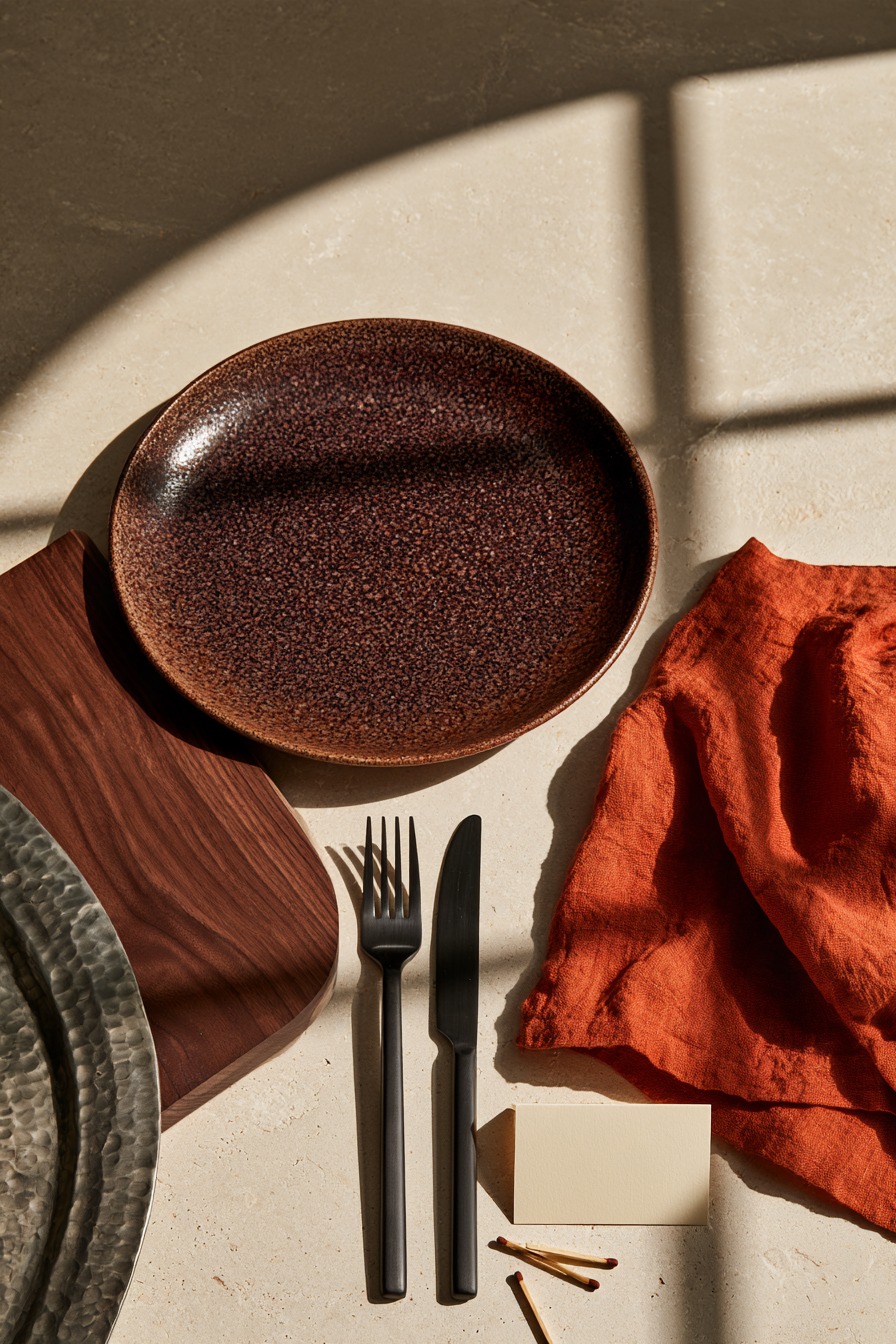
Set one place and you've set the table. Here are five pieces that share the palette without matching exactly. The links are examples of each piece, so shop whatever suits you:
The charger: a charger is a large flat plate that sits under the dinner plate, like a frame. This one has an aged pewter finish and a softly scalloped edge, so it reads as weathered metal and picks up the candlelight instead of going flat. Vintage-Inspired Pewter Charger, Magnolia
The plate: handmade stoneware in a muted purple glaze over dark brown clay, so the purple takes on a smoky, speckled depth. Each plate is wheel-thrown, which means no two are exactly alike. They're about 10.5 inches across and safe for the microwave and dishwasher. Purple Pottery Dinner Plates, Set of Four, DragonflyPotteryCom on Etsy
The napkin: a cotton napkin in deep burnt orange. The fabric has a soft, slightly crinkled look that folds unevenly and catches the light in small planes. It's the one bright color on the table. Cotton Dinner Napkins in Burnt Orange, VTILENE on Etsy
The flatware: brushed black stainless steel. A matte black finish doesn't throw hard reflections the way polished steel does, so it stays quiet in the candlelight, and it hides fingerprints. Each place setting is five pieces: a dinner fork, salad fork, knife, soup spoon and teaspoon. It's dishwasher safe. Fortessa Arezzo Brushed Black Flatware Place Setting, Williams Sonoma
The place card: a small card of heavy, uncoated paper with the guest's name in dark ink, tucked into the napkin fold. Uncoated paper doesn't glare, and it's the first thing a guest touches. It tells them you were thinking of them before they walked in.
Notice the mix: speckled glaze, soft fabric, aged and matte metal, soft paper. In the dark, a table reads by texture as much as by color, and mixing finishes keeps it from looking flat.
Starting from scratch? You don't need all five pieces to begin. A dark plate, one colored napkin and a handwritten card is plenty.
Keep the center of the table low. Dried branches, seed pods and dark fruit all work, especially fruit that's already in the palette: figs, persimmons, black grapes, pomegranates. Everything stays below eye level so guests can see each other. One low arrangement beats three tall ones in candlelight.
V. Plan the Menu
In low light, you see food by its color and shine. Pale food disappears. Deeply colored, glossy food, which is most of what October cooking already is, looks its best by candlelight.
Cook dishes that hold, meaning they can sit and wait without suffering, so you spend the evening at the table instead of at the stove. Here's a sample shape for the night:
On arrival: an Americano, which is Campari, sweet vermouth and soda with an orange twist. It's bitter and bright, and it brings the tangerine into the room before anyone sees the table. Non-alcoholic: pomegranate juice and soda with an orange twist.
To start: roasted grapes on whipped ricotta toast. Sweet, sharp and deep purple, so it belongs to the palette.
The main: braised short ribs, with dark greens and roasted roots. They cook slowly ahead of time and get better as they sit, which means you can stay at the table.
To drink: a bold red with some weight. A Cabernet Sauvignon is an easy one to find, and it's sturdy enough to stand up to short ribs. Non-alcoholic: the same pomegranate and soda from arrival, served in a wine glass with a sprig of rosemary, so it feels just as considered.
To finish: dark chocolate pots de crème, which are small cups of rich chocolate custard you make the day before. Serve them with espresso on the side.
The music is part of the meal. Keep it soulful, slow and quiet. If you can hear it over the conversation, it's too loud. Build a playlist long enough that you never have to touch it again once guests arrive.
VI. Plan the Evening
A dinner by candlelight runs longer than a daytime one, so it helps to plan it in three parts:
The invitation: send it two weeks ahead, and say the time plainly. "Dinner at seven, we'll be eating by candlelight." It sets the mood before anyone arrives and tells guests what to wear.
Arrival: a lamp on in the entry, a drink in hand within a minute of walking in, and a place to put coats that isn't a bed. Leave a throw on the arm of a chair for anyone who gets cold.
After dinner: stay at the table. Don't rush to clear, and don't turn the lights up. Let the candles burn down and the conversation slow. Keep a small bowl of something sweet and a spare pair of reading glasses nearby, because cards and menus are harder to read by candlelight.
The best sign you got it right is when someone looks at the time and is surprised it's that late.
VII. Plan the Night
Three free printables to take the planning off your mind. Print them, keep them where you'll see them, and cross things off as you go.
The Dinner Party Checklist: everything in the order you will need it, from two weeks ahead to the last candle. Download the checklist
The Invitation Timeline: when to ask, what to say, and when to stop worrying. Download the timeline
The Guest List Planner: who is coming, what they eat, and who sits where. Download the planner