
Often, the smallest details are the ones that bring a space together, yet they are also the easiest to overlook when planning a gathering. The texture of the napkin, the warmth of the lighting, the paper chosen for the table—each may seem minor on its own, but together they create the atmosphere we remember.
When hosting, it is easy to focus on the pieces that feel most prominent: the dinnerware, the food, the flowers, the centerpiece. These elements matter, of course, but they cannot create a complete experience without the quieter details surrounding them. One of the most important of those details is paper.
For many gatherings, the invitation is the only piece of paper a guest encounters. It plays an important role, setting the tone before anyone arrives, but the experience of paper does not have to end there. When carried throughout a gathering, paper becomes part of the atmosphere itself.
Paper is also one of the easiest elements to decide against incorporating. It can seem unnecessary when compared with the larger pieces of an event, but leaving it out means overlooking one of the simplest ways to transform how a gathering feels.
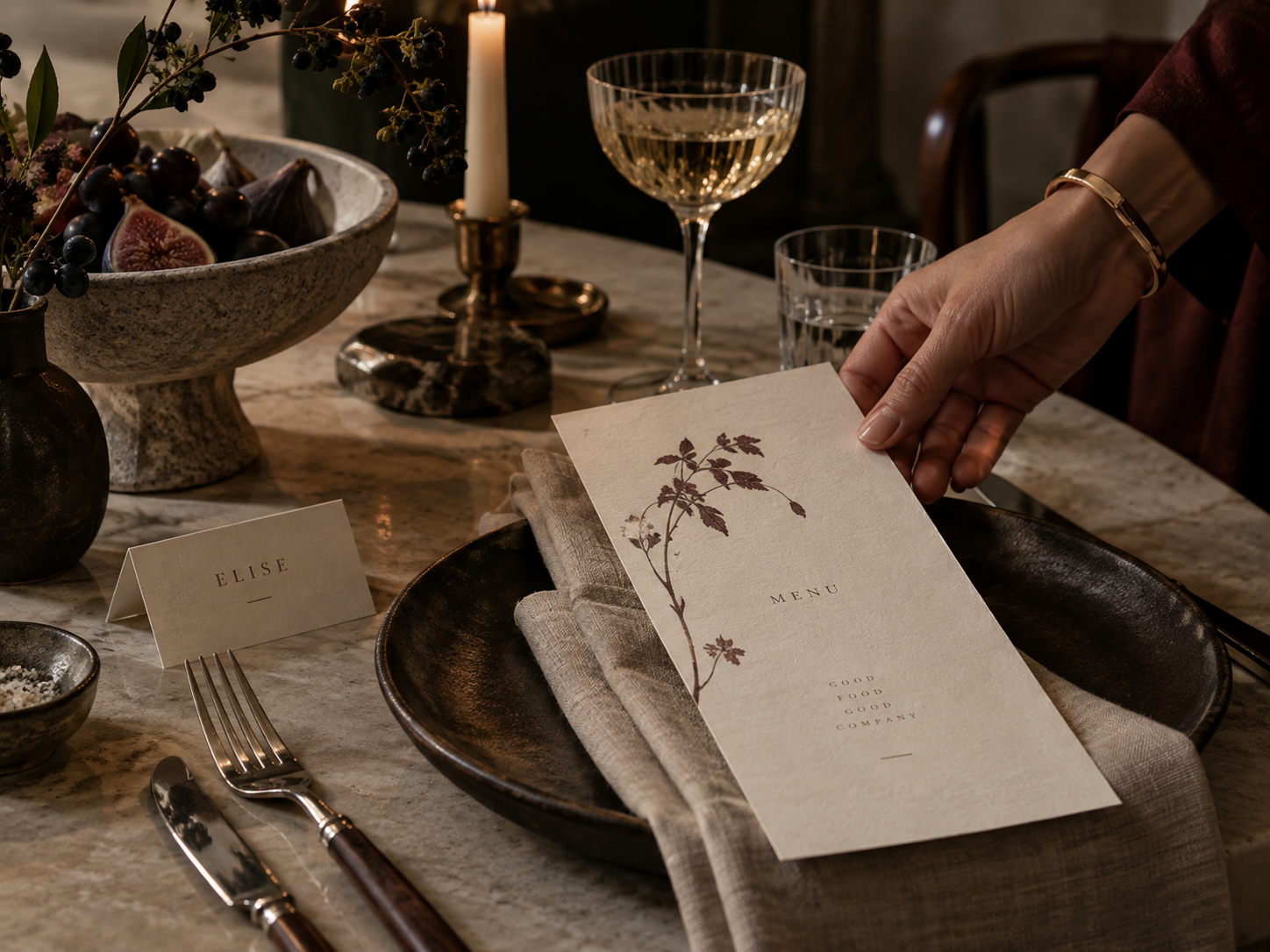
At the table, paper adds intention, structure, and a sense of occasion. A place card does more than tell a guest where to sit. It signals that their place was considered before they arrived. That small gesture creates a feeling of welcome and belonging while taking a table from simply set to thoughtfully composed.
A menu is often treated as a functional piece—something that tells guests what they will be eating. Visually, however, it can do much more.
Placed at each setting, a menu becomes another layer within the composition of the table. It can introduce contrast against linen, soften the hardness of ceramic and glass, or carry a color from the flowers or surrounding room directly into the place setting.
The shape matters. The weight of the paper matters. The typeface matters. Even the amount of empty space on the page can change how the table feels.
A thick cotton paper with restrained typography creates an entirely different experience from a brightly colored card with expressive lettering. Neither is inherently better. What matters is that the paper belongs to the atmosphere you are trying to create.
This is where paper begins to feel less like stationery and more like an object.
It occupies space. It interacts with the materials around it. It becomes part of the visual rhythm of the setting in the same way a glass, candle, or floral arrangement does.
Creating an experience begins with seeing the larger vision and then curating the pieces that bring it to life. Every object has a purpose, but it is the relationship between those objects that creates something memorable. A gathering becomes more than an assortment of beautiful things—it becomes an experience.
Explore the Pressed Paper Co. Paper Collection
A beautiful table is not simply a collection of beautiful objects. It is composition. It is thought. It is expression.
There are moments of height and moments of quiet. There are areas that draw the eye and others that allow it to rest. Repetition gives a table structure, while variation keeps it interesting.
Paper can help create that rhythm.
A menu repeated at every place setting establishes order across the table. Place cards introduce smaller points of detail. A bar menu or printed sign can carry the same typography, color, or visual language into another part of the room.
These repetitions are subtle, but they help the entire gathering feel connected. The goal is to create something immersive—an environment where each element feels as though it belongs to the same story.
Without these details, the table can still be beautiful. With them, however, it begins to feel intentional.
That distinction matters. A thoughtful gathering does not necessarily require more things. Often, it simply requires the things already present to feel connected to one another.
Perhaps the most meaningful role of paper has very little to do with design.
A place card communicates something incredibly simple: there was a place prepared specifically for you.
Before a guest arrived, someone considered where they would sit. Their name was written or printed. A seat was chosen. Their presence was anticipated.
That feeling of being expected is one of the quiet pleasures of hospitality.
It does not require an elaborate dinner or formal occasion. A handwritten name on a small card can create the same feeling at a dinner for six as it can at a large celebration.
There is something intimate about seeing your name waiting at a table.
It turns an open seat into your seat.
And in a world where so much communication exists temporarily on screens, a physical object bearing someone's name carries an unusual amount of weight. It creates a small moment of recognition: you were thought of, you belong here, and this place was prepared with you in mind.
Calligraphy Pen for Handwritten Place Cards
Paper is tactile, which is one of the reasons it can have such a strong effect on a table.
We notice the difference between a thin sheet and a substantial card before we consciously think about it. We feel texture when we pick something up. We notice a deckled edge, a soft cotton finish, or the slight impression left by letterpress.
These qualities create a sense of permanence.
The same principle applies throughout the table. Linen feels different from polyester. Crystal feels different from ordinary glass. Stoneware feels different from melamine.
The material itself contributes to the experience.
Paper should be considered in the same way.
Rather than choosing it at the very end simply because a menu is needed, consider it alongside the linens, candles, flowers, glassware, and dinnerware. Each object has a purpose, and when moving from an average table to an elevated one, the details begin to matter even more.
It is easy to set a table with plates, glasses, and napkins. Creating an atmosphere requires more consideration. Texture, color, shape, weight, scale, and material all influence how a space is perceived.
The scene you create—and the feeling it leaves behind—comes from those decisions.
Ask how the paper should feel in the hand. Consider whether the finish should be soft or crisp. Think about how it will sit against the plate or napkin beneath it.
Even simple materials can feel elevated when they have been chosen deliberately.
Handmade Stoneware Serving Bowl
Paper on a table does not exist in isolation. The light falling across it changes its color, texture, and presence.
Bright overhead lighting can flatten even the most beautiful materials. Warm, lower lighting creates depth. Candlelight catches the edge of a glass, softens the surface of linen, and makes the texture of paper more noticeable.
This is why lighting should be considered part of the table rather than simply part of the room.
A gathering often feels more intimate when there are several small sources of warm light instead of one bright source overhead. Taper candles, shaded table lamps, and low rechargeable lamps create pools of light that give different parts of the table their own atmosphere.
Before choosing the lighting, ask what you want the space to feel like. What should it create? What story should it tell?
A dinner, party, or meal can be more than the occasion itself. With enough thought, it becomes a moment, a memory, and eventually part of a larger story.
One of the reasons an invitation is so powerful is that it begins the experience before the gathering actually takes place.
A guest receives a small glimpse of what is to come—the colors, typography, mood, or level of formality.
When those same visual cues appear again at the gathering, there is a sense of continuity.
The invitation was not simply an announcement. It was the first chapter.
The menu, place card, bar sign, or itinerary continues the visual language introduced before the guest ever walked through the door.
This does not mean every paper piece needs to match exactly. In fact, a gathering often feels more sophisticated when the pieces relate rather than repeat.
Luxury is rarely about copying and pasting the same idea again and again. It is about envisioning, gathering, and composing.
Perhaps the invitation introduces a deep green, while the menu uses only a thin line of the same color. Maybe a floral illustration appears prominently on one piece and then returns as a much smaller detail on another.
The goal is not perfect coordination.
It is recognition.
Each piece should feel as though it belongs to the same world without needing to look exactly the same.
It is easy to think of paper as another decorative layer, but its value goes far beyond appearance.
Menus give guests context. Place cards create ease. Small signs guide people without requiring constant explanation. An itinerary creates anticipation for what comes next.
Together, these details do more than create a visual world for guests to enter. They also create a sense of ease.
When information is thoughtfully provided, there are fewer interruptions, fewer questions, and less uncertainty. Guests understand where to go, where to sit, what is being served, and what is coming next. The gathering can unfold more naturally because the design is quietly doing part of the work.
Good design is often most successful when beauty and usefulness exist together.
A menu can be beautiful while helping a guest understand the meal. A place card can enhance the composition of a table while removing the uncertainty of where to sit.
That combination of function and beauty is what makes paper particularly valuable at a gathering.
It does not simply decorate the experience.
It participates in it.
When styling a table around paper, the goal is not to surround it with as many decorative objects as possible. Instead, choose a few materials that allow the paper to feel integrated into the setting.
A menu placed over a softly folded linen napkin feels different from the same menu sitting directly on a bare plate. A simple brass place-card holder introduces a small glint of metal. A handmade ceramic bowl filled with seasonal fruit can bring color into the center of the table without competing with the individual place settings.
Even the smallest object—a ribbon, a piece of fruit, a sprig, a clip, or a beautiful pen—can help connect the paper to the materials surrounding it.
The goal is not abundance for the sake of abundance. It is choosing objects that support one another.
A table feels most considered when no single element is responsible for creating the entire atmosphere. The paper, linen, glassware, lighting, serving pieces, flowers, and food each contribute something different.
Together, they create the whole.
The most memorable gatherings are rarely memorable because every element was expensive or elaborate.
They are memorable because something about them felt considered.
The candlelight was warm. The music suited the room. The food arrived at the right moment. Someone remembered where you liked to sit. Your name was waiting for you at the table.
Often, it is the unexpected, thoughtful details that feel the most meaningful—and the most luxurious.
Luxury does not always come from excess. Sometimes it is simply the feeling that someone thought a little further than they had to.
Paper belongs among these details.
A menu or place card may occupy only a small amount of physical space, but it can carry an unexpected amount of meaning. It tells guests that the gathering did not begin when they arrived. Thought was given to the experience long before that moment.
And perhaps that is why paper continues to matter.
It transforms information into something tangible. It gives an atmosphere a physical form. It turns a table from a collection of objects into a composed setting—and a gathering into something that feels intentionally made for the people who are there.