
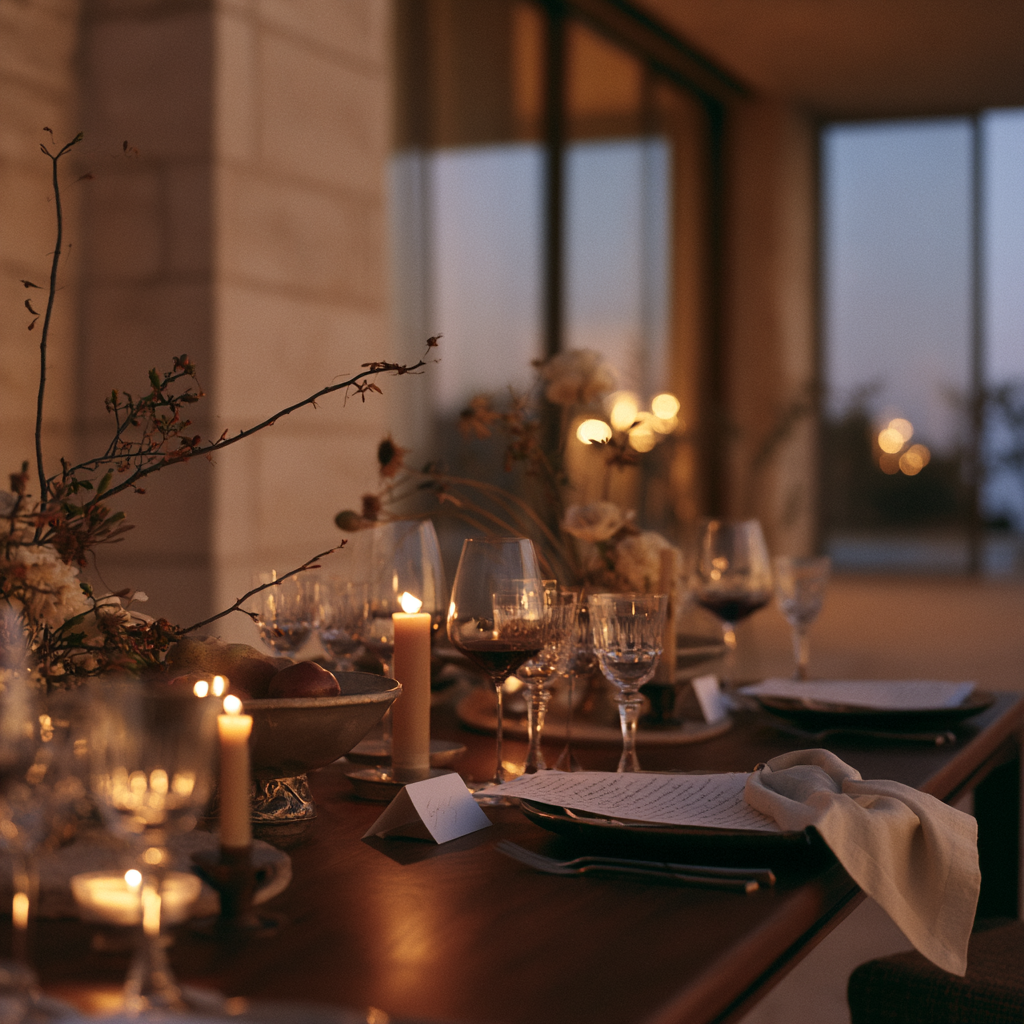
There are certain details we remember long after an evening has ended. A menu resting at each place setting. The glow of candlelight reflected in a wine glass. A handwritten name on a place card. The sound of conversation carrying across the table. An invitation tucked into a drawer months after the occasion it announced.
Individually, these details can seem small. Together, they create something larger: the feeling that a moment mattered enough to be considered. That is the heart of gathering well.
Not perfection. Not performance. Attention.
Beauty is often treated as something superficial—something added only after everything more important has been taken care of. But beauty changes the way a space feels. It can soften a room, create anticipation, and alter the energy of an entire evening. When someone walks into a space that has been thoughtfully prepared, they may not immediately recognize every individual detail, but they can feel the intention behind them.
The candle that was lit before they arrived.
The flowers chosen for the table.
The linen folded beside their plate.
The music already playing in the background.
Together, these choices communicate something simple: you were expected, and your presence matters. That is what thoughtful hosting is really about. Not creating a perfect setting, but creating an experience that feels welcoming, beautiful, and memorable—even when the occasion itself is ordinary.
The objects that compose a space quietly carry its mood.
They may not be noticed at first glance. Instead, they reveal themselves gradually as a guest moves through the evening—the invitation they received beforehand, the glass placed in their hand, the menu waiting at their seat, the small details that make the gathering feel complete.
Paper is one of the simplest ways to create that sense of intention.
An invitation is often the first glimpse of an event. Before the table is set or the candles are lit, it begins to establish the atmosphere and gives guests a sense of what is to come. A dinner menu can transform even a familiar meal into something that feels like an occasion. A place card can turn an ordinary seat into someone's place at the table. These pieces do not need to be elaborate to matter. What matters is that they were chosen with intention. Because when each detail has a purpose, the gathering begins to feel less like something that simply happened and more like something that was created.
A memorable room is rarely defined by one beautiful object. It is created through the relationships between them. The warmth of wood beside cool stone. Soft linen against polished silver. Candlelight reflected through glass. Flowers that introduce movement and color. Paper that adds something personal among all of those materials.
Each element contributes something different, but none of them need to compete for attention. The most inviting spaces often feel layered rather than decorated. Light, texture, scent, sound, food, and objects work together quietly, creating an atmosphere that is felt before it is fully noticed.A guest may not remember the exact candleholder or the particular linen used at dinner, but they will remember how the room made them feel.
Warm.
Welcome.
At ease.
That is the purpose of atmosphere. It is not about creating a setting so beautiful that no one wants to disturb it. It is about creating a setting that invites people in and gives the evening somewhere to unfold. It should feel elevated, but attainable. A beautiful room should support the gathering, never overshadow it.
Many of the rituals surrounding gathering are old ones. We send invitations. We set places at the table. We raise glasses. We bring flowers. We serve food to one another.We mark birthdays, marriages, holidays, arrivals, departures, and ordinary evenings that somehow become important in retrospect.These gestures may feel familiar because they have been repeated for generations. That familiarity gives them weight.
Tradition connects an ordinary moment to something larger than itself. A toast made at dinner, a name written on a place card, or a table set for a holiday carries echoes of the countless gatherings that came before it. But tradition does not have to mean formality. It can be interpreted. Changed. Simplified. Made personal. A family recipe can be served on modern dinnerware. An old holiday ritual can be given new meaning. A formal tradition can become something quieter and more intimate.
The point is not to recreate the past exactly. It is to recognize that rituals give us a reason to pause. They ask us to notice the people around us, the season we are in, and the moment we are living through before it becomes a memory.
Not every gathering needs a reason. Some of the most meaningful tables are set on an otherwise ordinary evening. After all, many of the days we eventually remember began as ordinary ones. Dinner can be served from the pot it was cooked in. Flowers can come from the grocery store. The wine does not need to be rare. The guest list does not need to be long. Meaning does not require spectacle.
Sometimes the difference is simply choosing to make the ordinary feel considered.Lighting the candles anyway. Using the glasses you usually save. Putting dinner on a serving dish instead of leaving it on the stove. Opening the bottle you have been waiting for the “right” occasion to enjoy.Writing someone’s name on a small piece of paper because you wanted their place at the table to feel like theirs.These gestures are small. That is precisely why they matter. They are easy enough to repeat. And when repeated often enough, they stop being special-occasion details and become part of the way a home is lived in.
A beautiful life is rarely built from a handful of extraordinary days. It is built from ordinary ones that were given attention.
There is a difference between a room that has been decorated and one that feels as though it belongs to someone. The same is true of a table. A meaningful gathering does not require everything to match. The linens can be slightly rumpled. The flowers can lean in unexpected directions. A serving bowl can tell a story through its scuffs and scratches. The silver can show its age. A favorite glass can sit beside something newer.These small inconsistencies give a table character. They make it feel collected rather than assembled.
And once the evening begins, the arrangement should change. A perfectly composed table is only the starting point. Then glasses move. Candles shorten. Napkins unfold. Serving dishes travel from one end of the table to the other. Someone pulls their chair closer. Another bottle is opened. A plate is pushed aside to make room for dessert.
By the end of the evening, much of the original arrangement has disappeared. What remains is something better: evidence that the table was used. That people stayed. That conversation continued. That the setting became part of a memory instead of remaining a picture. Perfection is never the goal.
Presence is.
This journal is a place for looking more closely at the details that shape the way we gather and live.
The composition of a table. The rituals surrounding hospitality. The materials that make a space feel considered. The history and meaning carried by paper.The changing character of the seasons. Objects worth keeping. Traditions worth continuing. And the quiet choices that turn ordinary moments into something we remember.
Some entries will be practical. Some will explore design, materials, and composition. Others will look at the rituals and traditions that have shaped the way we gather, entertain, celebrate, and care for the people around us. There will be beautiful objects here, but the object itself is never really the point. A glass matters because of what is poured into it. A menu matters because of the meal shared around it.An invitation matters because someone is being asked to come. A table matters because people eventually sit around it.
That is the idea at the center of this journal. Beauty is not the purpose of gathering. It is one of the ways we show that the gathering matters. The flowers, the paper, the candlelight, and the carefully set table are simply creating the setting.
The people are the reason we create it.